
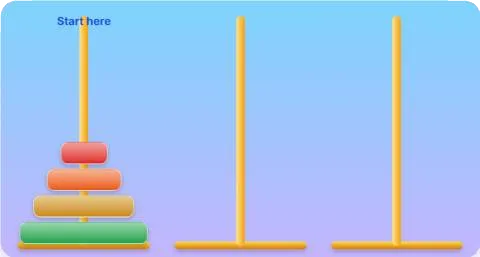
How to play Tower of Hanoi
- All the disks start on the left peg, the biggest at the bottom.
- Tap a peg to pick up its top disk, then tap another peg to drop it. On a keyboard, keys 1, 2 and 3 pick the pegs.
- Move one disk at a time, and always put a disk on a bigger one or on an empty peg.
- Rebuild the whole tower on the right peg to win.
Tips
- With an odd number of disks, move the smallest disk first to the right peg; with an even number, to the middle peg.
- The smallest disk moves every other turn, always in the same direction around the pegs.
- Between two moves of the smallest disk, there is only one legal move left: make it.
- The best possible score is 2 to the power of the number of disks, minus 1: 7 moves for 3 disks, 31 for 5.
- Stuck after a few wrong moves? Hint shows the best next move from where you are, and Undo takes a move back. The diamond badge is for a perfect tower with neither.
About Tower of Hanoi
The Tower of Hanoi was invented by the French mathematician Edouard Lucas in 1883. A legend tells of monks moving 64 golden disks: at one move per second, they would need almost 600 billion years.
It is a perfect lesson in breaking a big problem into smaller ones: to move a tower of five disks, first move the four on top, then the big one, then the four again. Four levels go from 3 to 6 disks, and the game tells you when you hit the perfect score.
Points and badges
Finishing a game of Tower of Hanoi earns points for your level. Four badges are waiting in this game, from bronze to diamond: each one says what to do and adds bonus points.
Questions
What is the minimum number of moves?
2 to the power of n, minus 1, where n is the number of disks: 7 for 3 disks, 15 for 4, 31 for 5 and 63 for 6.
Why can't I drop a disk on some pegs?
A disk can only go on an empty peg or on a bigger disk.
Do I get a bonus for a perfect game?
Yes. Solving the tower in the minimum number of moves earns extra points.