
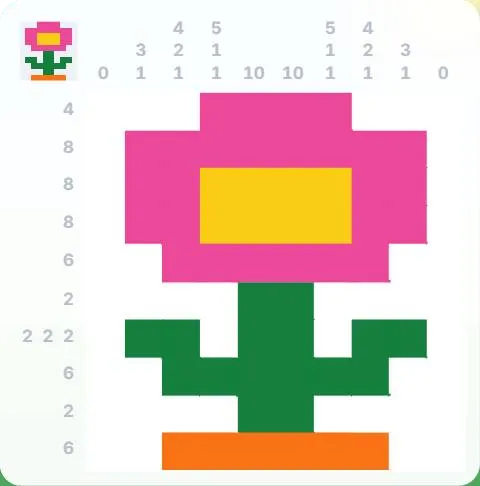
How to play Nonogram
- The numbers beside each row and above each column give the runs of filled squares in that line, in order. 3 1 means a run of three, at least one empty square, then a single one.
- Tap a square once to fill it, a second time to put a cross on it, a third time to clear it. Drag to do the same along a row or column; on a computer, the right button puts a cross directly.
- On a keyboard, the arrows move, Space fills and X crosses.
- Win when every row and column matches its numbers: the hidden picture appears in color.
Tips
- Start with the big numbers: in a line of 10, a run of 7 always covers the 4 middle squares, wherever it sits.
- A line whose numbers plus the gaps between them fill the whole length can be filled at once.
- Cross the squares you are sure are empty: they cut the line into smaller pieces that are easier to solve.
- Every grid is a real picture (a cat, a rocket, a house...) that pure logic solves, with no guessing: if you are stuck, there is always a deduction left. Hint fills a square and Check shows mistakes; the diamond badge is for Hard grids solved without them.
About Nonogram
Nonograms were invented in Japan in the late 1980s and spread through newspapers in the 1990s, under names like Griddlers, Hanjie or Paint by Numbers.
Here each grid hides a real picture, a heart, a cat, a rocket or an owl, revealed in its colors at the end. Every picture is checked by a solver: line-by-line logic solves it completely, so it has a single solution. Three levels go from 5 × 5 to 15 × 15, a How to play card explains the rules with examples, and settings gray out finished numbers or add crosses automatically. A small preview in the corner of the grid shows the picture taking shape, and a counter keeps track of the pictures you have found.
Points and badges
Finishing a game of Nonogram earns points for your level. Four badges are waiting in this game, from bronze to diamond: each one says what to do and adds bonus points.
Questions
Do I have to guess at some point?
No. Every grid is checked by a solver that only uses logic, line by line, before you get it: there is always a square you can be sure of.
What is the cross for?
It marks a square you know is empty. It is not required to win, but it helps you see the pieces of each line that are left.
Does Undo count against the badges?
No. Only Hint and Check count: the diamond badge asks for three Hard grids solved without them.